Short answer: Vaseline is 100% petroleum jelly. Most famous paw paw ointments are more than 90% petroleum jelly with a little paw paw added, so they work the same way: they seal the skin but add no moisture. A natural paw paw cream, made on aloe vera and plant oils, moisturises instead of sealing. That is the whole difference.
Turn over the most famous paw paw products (also spelled pawpaw or papaw, and known as papaya, popo, or botanically Carica papaya) in Australia and read the first ingredient. On many of them — and on a tub of Vaseline — it isn’t paw paw. It’s petrolatum, better known as petroleum jelly. Often more than 90% of the tube.
What is petroleum jelly (and Vaseline)?
Vaseline is the best-known brand of petroleum jelly — petrolatum, a by-product of oil refining, the same industry that fuels cars. It has been used in skincare for over a century because it’s cheap, extremely stable, and forms a waterproof seal over the skin. To be fair and honest: petroleum jelly is permitted in cosmetics and considered safe by regulators. This isn’t a scare story.
It’s a choice story.
Paw paw cream vs Vaseline: two philosophies
Vaseline and petroleum-based ointments work by sitting ON your skin — a thick, greasy barrier that seals things in (and out). The fruit content, if there is any, is usually a small percentage carried in that petroleum base.
A natural paw paw cream works differently — the plant oils and the fruit’s own goodness soak into the skin as well as protecting it, with no petroleum base. The fruit isn’t a garnish; it’s the point.
What’s the difference between paw paw cream and Vaseline?
Honestly, they’re different tools. If you want a plain waterproof seal, petroleum jelly like Vaseline does that one job. But if you want skincare made with real paw paw on a plant base — that absorbs rather than just sitting there greasy, and is petroleum-free — that’s a different product built for a different reason. That’s the choice we made.
How we make ours
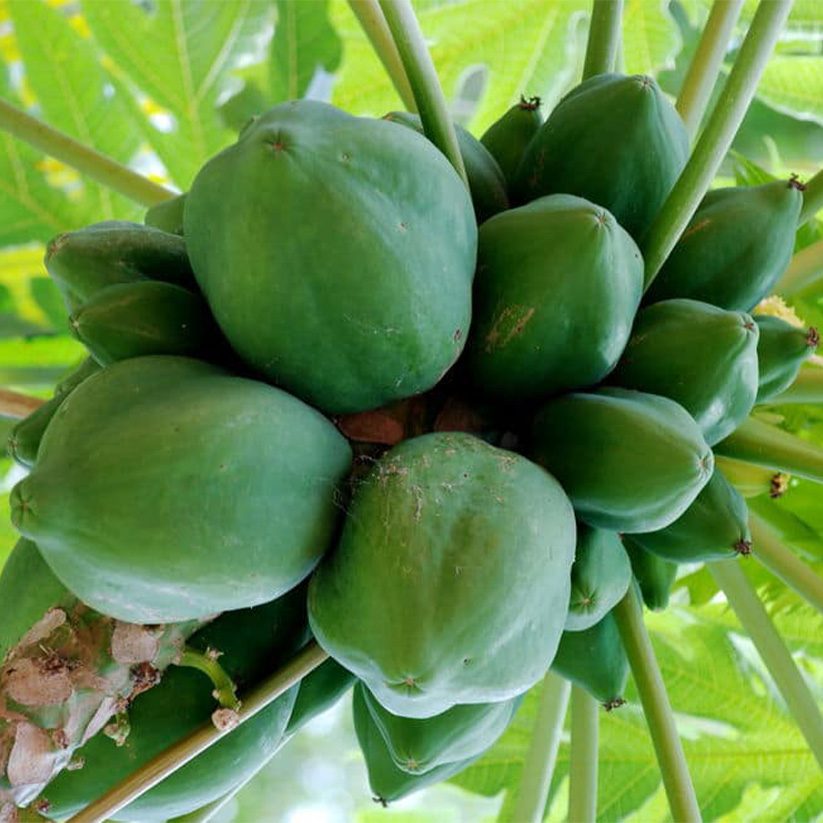
Our Paw Paw Magnesium Body Cream contains no petroleum — it’s built on an organic aloe vera base, not a petroleum jelly base like Vaseline. It carries 60% real Australian paw paw from Australian organic growers, certified-organic aloe vera juice where most creams use plain water, magnesium, and natural plant oils and butters — with less than 1% preservative in the whole formula. It’s a paw paw cream and a magnesium cream in one — a combination you won’t find in the big-name petroleum tubes. Vegan and cruelty-free throughout, made in Australia. Every ingredient is on our ingredients page.
Which should you choose?
| Vaseline / petroleum ointment | Real McArthur paw paw cream | |
|---|---|---|
| First ingredient | Petrolatum (petroleum jelly) | Paw paw and plant ingredients |
| Base | Petroleum jelly | Organic aloe vera (petroleum-free) |
| Paw paw content | Small % (if any) | 60% |
| Feel | Thick, greasy seal | Absorbs in, still protects |
| Origin of base | Oil refining | Plants, grown in Australia |
| Vegan | Usually no | Yes |
If you want a waterproof seal, a petroleum ointment like Vaseline does that job. If you want skincare that feels like it came from a fruit rather than a refinery — that’s why we exist. We’ve written a full paw paw ointment vs cream comparison here.
Quick answers
They work differently. Vaseline is petroleum jelly that sits on the surface as a seal. Real McArthur paw paw cream is built on an organic aloe vera base with 60% Australian paw paw, so it works into the skin as well as protecting it. Many people prefer a plant-based, petroleum-free option.
Many traditional paw paw ointments are mostly petroleum jelly, the same base as Vaseline, with only a small amount of paw paw. Real McArthur paw paw cream is different: it’s petroleum-free, built on an organic aloe vera base with 60% paw paw.
Yes. There is no petrolatum, paraffin or mineral oil in it. It’s built on an organic aloe vera base, not a petroleum jelly base like Vaseline. Plant-based, vegan and cruelty-free.
Petroleum jelly, or petrolatum, is a by-product of oil refining, best known as Vaseline. It has been used in skincare for over a century because it’s cheap and forms a waterproof seal. It’s permitted and considered safe in cosmetics; our choice to build on aloe and paw paw instead is about plant-based values and how a cream feels.
Yes. Our body cream combines magnesium with certified-organic paw paw and aloe vera. If you’re searching for a magnesium cream in Australia, ours is built on fruit and aloe, petroleum-free.
From the fruit, not the refinery.
Shop natural paw paw cream →
Keep reading: paw paw ointment vs natural cream · why we blend magnesium into our paw paw cream · paw paw salve vs cream
Paw paw ointment vs Vaseline: the questions people ask Google
What are the disadvantages of paw paw cream?
If it is petroleum-based, it can feel greasy and sit on the skin without adding moisture. If it is a natural cream, the main disadvantage is price. Either way, patch test if your skin is sensitive; it is a cosmetic, not a medicine.
What do dermatologists think of Vaseline?
Many dermatologists are happy with petroleum jelly as a sealant: it is cheap, stable and very unlikely to irritate. The point they also make is that it adds no moisture of its own. Our cream takes the other road: aloe vera and plant oils that moisturise, with no petroleum at all.
Can I use paw paw ointment on my face?
Petroleum-based ointments can feel heavy on the face. For the face we make a light paw paw face cream with hyaluronic acid and Kakadu plum, and we keep the richer magnesium body cream for hands, elbows, heels and feet.
Is paw paw ointment good for wrinkles?
No ointment or cream removes wrinkles. Well-moisturised skin looks smoother, which is what a good face cream is for. Anything promising more than that is not a cosmetic claim.
Does paw paw cream contain steroids?
Ours does not, and no genuine paw paw cosmetic should. Steroid creams are medicines, sold through a pharmacy. Our full ingredient list is on every product page.
Prefer your vitamin C from the inside as well? Our Kakadu plum capsules are lab tested at 240 times the vitamin C of a fresh orange, gram for gram.